Expected 100% of Students to Learn English as a Second Language by 2035
All students and undergraduates are expected to study the English as a Second Language program from 2035, according to plans from the Ministry of Education and Training.
This content was stated by the Ministry at a conference to gather opinions on the draft national project to step-by-step make English a second language in schools for the 2025-2035 period, with a vision to 2045, on March 5.
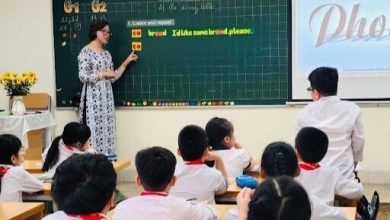
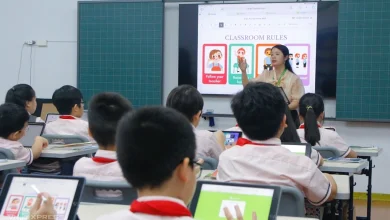
In terms of concept, this means that English is taught and learned in schools where the official language is Vietnamese, but the primary language used is English. English is both a subject and a medium used to teach other subjects and applied in work and daily communication.
The Ministry expects to implement this across 6 levels, though specific details have not yet been announced.
The goal by 2035 is that all preschools meeting the requirements will implement English as a second language, with 100% of children aged 3-5 benefiting. For general education, all will study this program according to levels 1, 2, and 3. The same applies to the university level for levels 4, 5, and 6.
For vocational education, 100% of schools will have an English as a second language program, specifically career-oriented English.
By 2045, all children will benefit from the program. All general education schools will implement English as a second language according to levels 4, 5, and 6.
The draft also specifies the tasks and solutions for implementation, including researching and perfecting institutions; strengthening communication to raise public awareness; developing and training a team of teachers and lecturers; and issuing and implementing curricula, textbooks, and materials…
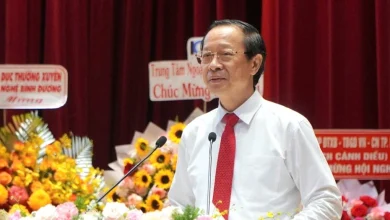
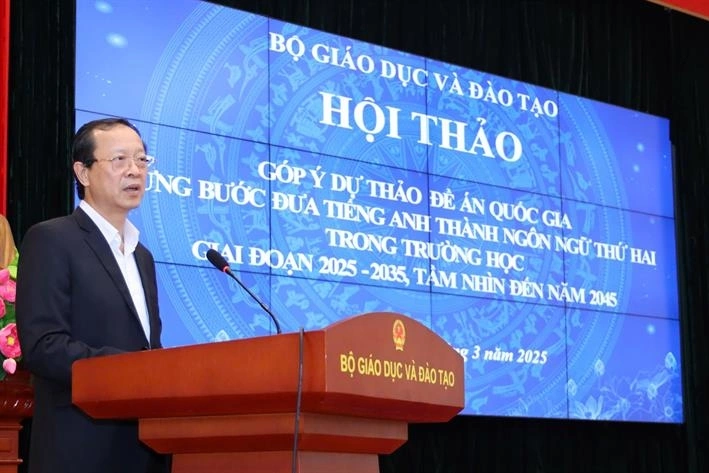 Deputy Minister Pham Ngoc Thuong speaking at the workshop on March 5. Photo: MOET
Last August, the Politburo requested all levels to improve foreign language capacity for students and undergraduates, gradually making English a second language in schools, according to the conclusion on the implementation of Resolution 29.
Deputy Minister Pham Ngoc Thuong said people are the most important factor. He emphasized the role of teachers and lecturers and the importance of training the team. In addition, digital transformation and the application of information technology in teaching will be used to resolve regional gaps and save time and human resources.
“We must also learn from international experience to select choices suitable for Vietnam’s educational characteristics, use resources effectively, train teachers, invest in infrastructure, and attract socialization to implement the project,” the Deputy Minister said.
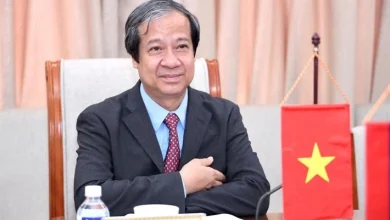
Assoc. Prof. Dr. Nguyen Van Trao, Vice President of Hanoi National University of Education, argued that it is necessary to clarify the role and planning of the higher education system, especially key pedagogical universities, in building curricula and materials to train teachers and pedagogical students. The Ministry needs to strengthen physical facilities and have specific plans for enrollment targets, financial support for teachers and students, and experts.
According to Mr. Do Tuan Minh, Chairman of the Council of the University of Languages and International Studies, Vietnam National University, Hanoi, to improve the project’s effectiveness, English must become a culture and an environment within schools. Localities and educational institutions need to be given space to implement based on their specific conditions.
Source: https://vnexpress.net/du-kien-100-hoc-sinh-hoc-tieng-anh-nhu-ngon-ngu-thu-hai-vao-nam-2035-4857309.html